Does Footwear Choice Actually Matter in the Dolomites?
The short answer is yes - but probably not for the reasons you expect. The Dolomites are not one type of terrain. A morning on the Alpe di Siusi (Seiser Alm) plateau, a scree descent off the Lagazuoi, and a via ferrata approach are three completely different surfaces demanding different things from your foot. The beginner mistake is treating “Dolomites hiking boots” as a single category and buying the most aggressive boot you can find.
What the terrain actually looks like: well-packed dirt and gravel on lower forest trails, compact gravel and rocky plateaus on mid-altitude paths, loose angular scree on descents from the high passes, and exposed limestone slabs with iron-fixed climbing routes on via ferrata. Each surface rewards a different sole geometry and rigidity. A boot optimised for scree descents is uncomfortable and overbuilt for a 2-hour plateau walk. A cushioned trail runner that handles the Seceda ridgeline perfectly will shred its upper in two weeks on a technical via ferrata approach.
The four footwear categories relevant to the Dolomites:
- Trail runners: lightweight, fast-drying, low stack. Best for marked-trail day hikes.
- Mid hiking shoes/boots: moderate stiffness, ankle coverage, durable upper. Best for multi-day routes with a loaded pack.
- Approach shoes: climbing-oriented sole, precise toe rand, compact profile. Best for via ferrata routes.
- B1/B2 mountaineering boots: fully stiff, crampon-compatible. Only relevant for early-season snow routes or serious alpine itineraries.
The framework below matches each to a use case.
What Should You Wear for Day Hikes from a Base?
This covers the majority of Dolomites visitors: staying in Cortina d’Ampezzo, Val Gardena (Ortisei or Selva di Val Gardena), or one of the valley towns, and doing day hikes on marked trails rated T (tourist path) to E (hiker’s trail) by the CAI (Club Alpino Italiano). Typical days: the Tre Cime di Lavaredo loop, Seceda ridgeline, Alpe di Siusi plateau, Lago di Sorapis, Cinque Torri.
Recommended: trail runners or low-to-mid hiking shoes.
The CAI E-rated trail network is well-maintained. Surface conditions are mostly compact gravel, flat rock, and packed earth. You are not teetering across loose boulders - you are walking a well-worn path with occasional rocky steps. A neutrally-cushioned trail runner with a grippy outsole handles this comfortably, and it does so while being lighter, faster-drying, and more comfortable over 15 to 20 km9 to 12 mi day distances than a stiff leather boot.
The rubber compound matters more than the boot-vs-runner debate. On wet limestone - which you encounter every time you cross a shaded couloir or walk through damp slabs after rain - the outsole rubber’s grip formula determines whether you move confidently or nervously. Soft-compound outsoles designed for alpine terrain grip wet rock substantially better than hard-compound treads of equivalent depth. An aggressive lug pattern in a cheap hard rubber will slide on polished limestone where a soft-compound trail runner with moderate lug depth holds firm. Check what compound is in any shoe you are considering.
Where day hikers go wrong: arriving in fashion trainers or road running shoes with flat outsoles. The other common error is buying heavy leather mountaineering boots for a week of T- and E-rated trail walking, then discovering that stiff soles make the descent from Passo Giau feel like wearing ski boots on stairs.
A note on the difficulty scale: trails are graded T (Turistico - cart tracks, mule tracks or obvious paths, no route-finding problems, modest slopes), E (Escursionistico - most hiking itineraries, on tracks, paths and sometimes faint traces), EE (Escursionisti Esperti - difficult or unreliable terrain, sometimes exposed, almost always marked, with possible snow patches) and EEA (Escursionisti Esperti con Attrezzatura - via ferrata, with harness, via ferrata kit and helmet). Most “tourist” Dolomites hiking sits in T and E. If your day touches EE terrain with sustained scree or exposure, a mid hiking shoe with some torsional rigidity is better than a minimalist trail runner. EEA means harness, kit and helmet - see the via ferrata section.
What Footwear Do You Need for Multi-Day Hut-to-Hut Treks?
Multi-day routes change the calculation. On the Alta Via 1 - the traverse of about 125 km78 mi and 7,300 m23,950 ft of ascent from Lago di Braies to Belluno, in twelve stages - you carry a pack of 8 to 12 kg18 to 26 lb for 8 to 11 consecutive days depending on how you split it, and part of the route crosses loose scree, boulder fields, and high-altitude rocky passes. The same applies to Alta Via 2, Alta Via 4, and other long traverses. How many days you are actually walking matters - see the trip-length guide if you have not decided yet.
Recommended: mid boots or low B1 boots with a firm midsole.
Three factors shift the choice away from trail runners on multi-day routes:
1. Load and fatigue. A trail runner that feels nimble on day one starts to transmit every sharp rock edge by day five. The midsole foam in trail runners compresses faster under repeated heavy load than the chassis of a dedicated hiking boot. After several days on the Alta Via 1, descending long stretches of scree, your underfoot protection matters more than it did on a fresh-legged day hike.
2. Scree descents shred footwear. Loose angular scree acts like sandpaper on mesh uppers. A trail runner with a knit or thin mesh upper will show significant wear on the lateral sidewalls after two or three full scree descents. A leather-panelled or reinforced synthetic mid boot survives the same terrain without damage. This is not primarily about ankle support - it is about the upper holding together for ten consecutive days.
3. Pack weight changes your gait. With a 10 kg22 lb pack, the stiffer shank of a hiking boot distributes load more evenly across uneven rocks and reduces the micro-adjustments your foot makes on each step. Over a full-altitude day, fewer micro-corrections means less cumulative fatigue. This effect is minimal on light day-pack loads but meaningful above 8 kg18 lb.
Ankle support. Do not choose a high-cut boot to avoid a sprain: gear marketing promises more than the cuff delivers. What hiking boots genuinely provide on multi-day scree terrain is lateral ankle protection against rock impact (the boot collar keeps sharp edges from bruising your ankle bone) and sole rigidity on loose scree (preventing the lateral splay that fatigues the arch and small foot muscles over hours). These are practical benefits. They are not the same as injury prevention.
Before you finalise any multi-day footwear choice, confirm your hut bookings are in order - the rifugi guide covers the booking window in detail. Rifugio Lagazuoi and other high-demand huts book up very early; footwear is a secondary concern.
What Should You Wear for Via Ferrata Routes?
Via ferrata routes involve fixed iron rungs, steel cables, and wooden stemples bolted into limestone faces. You are on vertical or near-vertical terrain using a harness and via ferrata set. The footwear logic here diverges from trail hiking.
Recommended: approach shoes or stiff mid boots with a close-lug, precise sole.
Two specific demands:
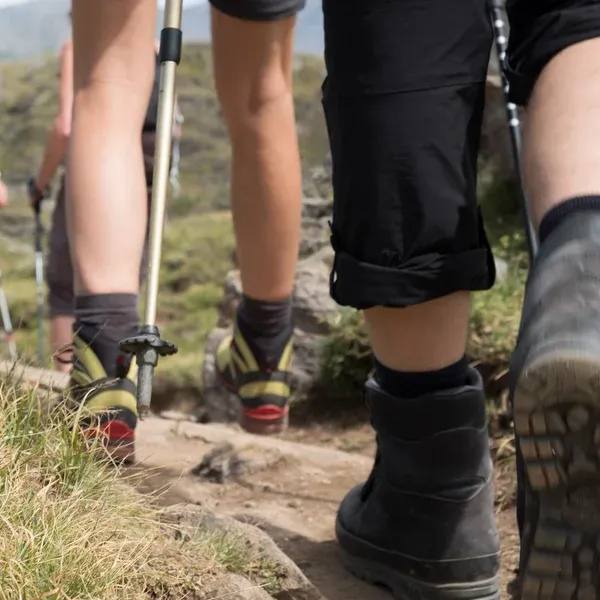
1. Edging on small iron rungs. The rungs on classic Dolomites via ferrata - such as the Ferrata degli Alpini on Col dei Bos, or the Ferrata Lipella on Tofana di Rozes - are narrow iron rods bolted into the rock. A cushioned trail runner with a thick midsole cannot edge on these precisely - the padding absorbs feedback and your forefoot sits above the rung rather than gripping it. A stiffer sole with a defined toe rand keeps your foot locked on the step. Approach shoes exist as a category specifically to bridge this gap: stiff enough for technical rock contact, durable enough for the walk-in.
2. The scree approach. Many via ferrata routes begin with a loose scree approach from the nearest trailhead. Pure rock climbing shoes are unusable here. Approach shoes handle both the technical section and the approach without compromise.
What about the “easy” equipped routes that most visitors do? The Galleria del Lagazuoi tunnel, graded EE (not EEA) by its operator, is one of them. It does not demand dedicated approach shoes - a firm mid hiking boot with good ankle coverage handles it. But it is poor terrain for cushioned trail runners, which wobble on the fixed rungs and provide poor feedback on polished limestone.
Climbing shoes are the wrong answer. Tight-fitting sport climbing shoes are only appropriate for actual sport climbing. They are unusable for approach walks and the trail sections that all Dolomites via ferrata involves. Do not confuse the two categories.
B2 mountaineering boots for via ferrata are only appropriate if the route involves snow or ice (lingering snow early in the season). In summer conditions, the fully-rigid sole provides poor sensitivity on warm rock and makes the walk-in punishing. Standard summer via ferrata calls for approach shoes or firm mid boots, not full mountaineering equipment.
Does Waterproofing (GTX) Make Sense for Summer Hiking?
Gore-Tex and equivalent membrane liners are a trade-off, not a universal upgrade. Understanding when the trade-off pays off is important because the Dolomites summer hiking window (mid-June to late September - see best time to visit) produces very different conditions at either end of that range.
The trade-off in plain terms: waterproof membranes block water ingress but significantly restrict moisture vapour escape. In temperatures above 18°C64°F, your foot generates more sweat than the membrane can exhale, and the interior becomes wet from the inside regardless of external conditions. Hot, wet interiors cause the friction conditions that produce blisters, and waterproof boots dry far more slowly when they do saturate - from stream crossings, wet grass, or rain that tops the boot cuff - than non-waterproof equivalents.
When GTX makes sense in the Dolomites:
- Shoulder season (late May to mid-June, and October): Consistent temperatures below 12°C54°F, prolonged wet snow patches, and cold-wet combinations where warmth retention justifies the trade-off.
- Multi-day autumn treks: If your route involves consecutive high passes above 2,500 m8,202 ft in September or October with unpredictable weather, a waterproof boot extends your dry window before cold becomes a problem.
When GTX does not make sense:
- July and August day hikes: Afternoon thunderstorms are fast and violent, but you should be off high terrain before they arrive. Your feet will not saturate in a short storm. Non-waterproof trail runners and hiking shoes dry faster and stay cooler in summer heat.
- Any low-altitude summer hiking below 1,800 m5,906 ft: No sustained wet terrain to justify the heat penalty.
The summary: for a July-August base-camp day-hiking trip, non-waterproof footwear is more comfortable. For a shoulder-season trip or a September-October hut-to-hut, waterproofing earns its weight.
What Else Should You Know Before You Lace Up?
Break-in is not optional. If you are buying new mid or high boots for a Dolomites trip, you need a minimum of 8 to 10 hours of real walking in them before you fly. Not a trip around a shop floor - actual walks on varied terrain with the socks you will wear hiking. Stiff boots that have not been broken in produce heel hot spots that, over a 7-hour descent day, become blisters bad enough to end a multi-day trek. Trail runners and approach shoes generally need less break-in time, but benefit from two or three pre-trip sessions nonetheless.
Socks matter as much as the boot. A stiff boot on a thin cotton sock will blister faster than a worn-in trail runner on the right sock. Use merino wool hiking socks in medium or heavy weight for multi-day routes and any day with significant descent mileage. Merino manages moisture better than synthetic in the temperature swings the Dolomites produces in a single day (cold early morning, warm midday, cold again at altitude), maintains cushioning when wet, and resists odour over multiple wear days. Carry at least one spare pair.
Blister management on long routes. On a 10-day traverse, a blister that is not caught early is a trip-ending risk. Experienced hut-to-hut hikers carry a small kit: hydrocolloid blister plasters, surgical or zinc-oxide tape for hot spots, and a sterilised needle. Tape any friction point the moment you feel it - not after it blisters.
Short trail gaiters are worth carrying on any route with significant scree. They prevent small stones from entering the boot cuff, which moves from minor irritant to significant problem on a long descent where stopping to empty the boot costs time and morale. They add almost no weight.