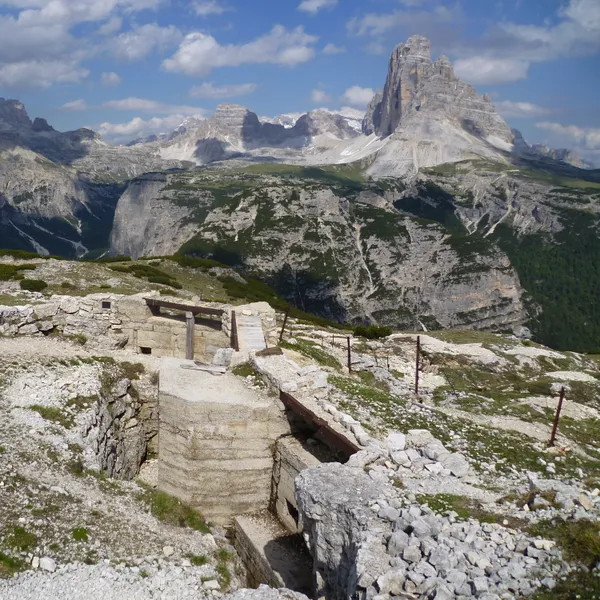
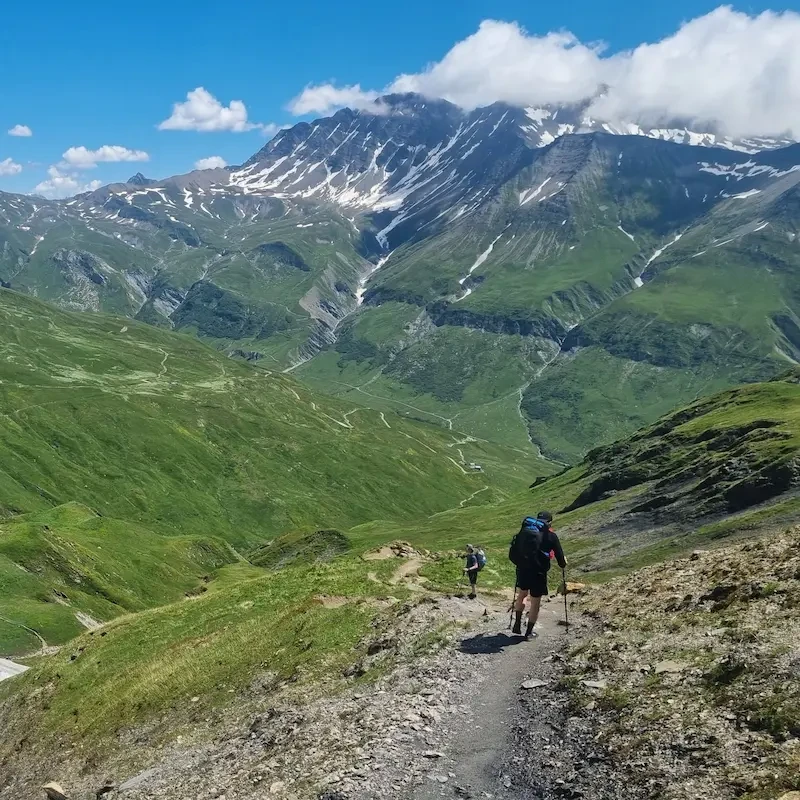
In the Dolomites, the old Great War front line can be walked: restored trenches, tunnels and forts line paths, some of them within anyone’s reach.
What Happened in the Dolomites During World War 1?
For two and a half years, from 1915 to 1917, Italy and Austria-Hungary faced each other along the crests of the Dolomites. Italy declared war on 23 May 1915 and its army occupied Cortina d’Ampezzo, which had belonged to the Habsburgs for four centuries. On 1 November 1917, after the defeat at Caporetto, it had to abandon the Dolomites front.
The Piccolo Lagazuoi held out for twenty-nine months, from May 1915 to October 1917, blocking the Passo Falzarego and the lower Valparola. The Marmolada became the highest battlefield of the whole Dolomites front.
What Can You Walk at the Lagazuoi and Cinque Torri Open-Air Museums?
The Lagazuoi, the Cinque Torri and the Sasso di Stria are three open-air Great War museums, and together with the Fort Tre Sassi museum they form a single group. These are mountain paths: walking boots and suitable clothing are required at the first two sites.
At the Lagazuoi, restored tunnels, trenches and machine-gun posts are crossed by paths, from the shortest and easiest to the longest and most demanding. The visit is free. The Sentiero del Fronte, wide and well marked, follows the old front line with no dangerous sections: it is the one to choose if you have never walked on exposed terrain. The Kaiserjäger path, demanding and exposed in places but fitted with cables, was the communication route between the valley floor and the high positions.
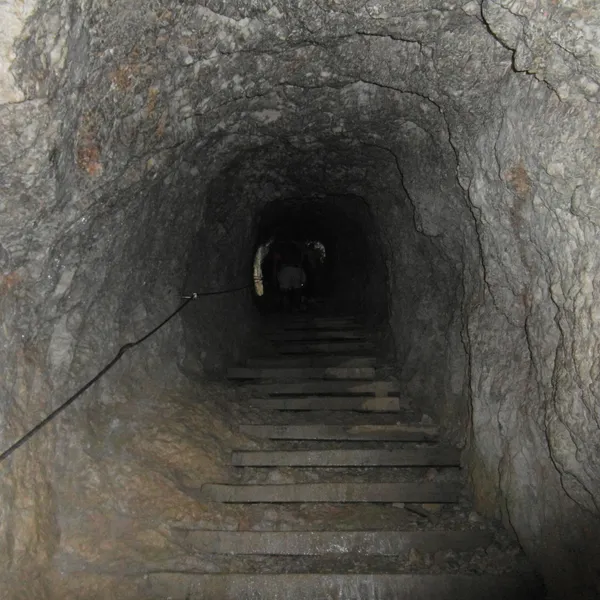
The Anticima tunnel is the one place not to miss. Italian soldiers dug it into the rock as a mine gallery, from the Cengia Martini to the top of the Anticima of the Piccolo Lagazuoi, and blew it up on 20 June 1917. Almost a kilometre long, it has been fully restored; our Lagazuoi page describes the descent. Bring a headlamp and a helmet, both recommended in the tunnels; the Lagazuoi open-air museum website maps its routes.
At the Cinque Torri, you ride the 5 Torri chairlift from Bai de Dones, and the museum starts five minutes from Rifugio Scoiattoli. You walk through trenches the soldiers dug and lived in, with signs in Italian, German and English. Four easy paths start there, from 20 minutes for the Trincea alta to about 2 hours for the loop around the Cinque Torri or the lake path. Our Cinque Torri page gives the loop around the towers and the chairlift prices.
To spend the night among these paths, there are two huts. Rifugio Lagazuoi is at the summit, and the tunnels can be explored straight from its doors; Rifugio Scoiattoli is five minutes from the start of the Cinque Torri museum, so you can walk the trenches first thing in the morning.
To make these paths the heart of several days of walking, four tours go through the Lagazuoi or the Cinque Torri: self-guided, from hotels near Cortina or from hut to hut between Bolzano and Cortina; guided, from a hotel in Cortina or from Verona to Venice:
What Is There to See at Sasso di Stria, Fort Tre Sassi and Col di Lana?
At the Passo Valparola, the Sasso di Stria (Sas de Stria) and Fort Tre Sassi show the other side of the front, the Austro-Hungarian one. The Sasso di Stria stands beside the pass road, between the Lagazuoi and the Col di Lana. The Austrians had made it one of their most important positions, with posts, trenches and tunnels up to the summit.
Fort Tre Sassi, at the foot of the Sasso di Stria, was built in 1897 to defend the Empire’s southern border, then renovated in 1910. Shelled from the Cinque Torri, it was evacuated after a few weeks of war. Restored and reopened in 2003, it displays soldiers’ equipment and everyday objects, more than 2,000 items gathered through research by the Lancedelli family.
The Col di Lana, in the municipality of Livinallongo, was the scene of fierce fighting until 1917. On 17 April 1916, an Italian mine of five tonnes of dynamite blew up part of it. The Col di Lana - Monte di Sangue museum, at the Passo Pordoi, is devoted to it.
How Do You Visit the Front on the Marmolada and Monte Piana?
On the Marmolada, the war is told in a museum at the Serauta station; on Monte Piana, you follow an open-air route on the very mountain the border cut through. In recent decades, the melting of the Marmolada glacier has given back objects that stayed trapped in the ice for more than a century.
The Marmolada Grande Guerra 3000 m museum, at the Serauta cable car station, was renovated and enlarged in 2015. Photos, short films, newspaper extracts and objects recovered from the glacier tell the story of the soldiers’ daily life. Much of the museum is given over to the Ice City, about 12 km7.5 mi of tunnels dug by the Austro-Hungarian army inside the glacier, down to 40 m131 ft deep. Funivie Marmolada, which runs the cable car and the museum, presents the rooms.
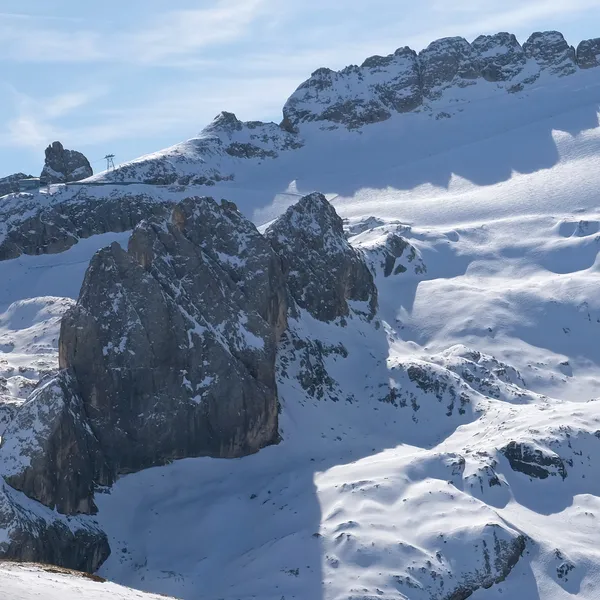
At the Passo Fedaia, by the lake, Rifugio Alla Seggiovia has housed a private two-room museum since 1997: some 700 items recovered from the glacier by the De Bernardin family, including a drill that was used to dig the Ice City.
At Monte Piana, the Austrians held the north summit, the Italians the south. The open-air historical museum follows restored tunnels, trenches and emplacements, and Rifugio Bosi keeps a collection of war objects.
Who Are the Ladins?
The Ladins are a linguistic minority of the five valleys around the Sella massif: Fassa in Trentino, Badia and Gardena in South Tyrol (Alto Adige), Livinallongo and Ampezzo in Veneto. Livinallongo is also called Fodom in Ladin and Buchenstein in German; Ampezzo is the Cortina valley, which our Cortina d’Ampezzo guide helps you explore.
Ladin is a Romance language, like Italian and French. It grew out of the Vulgar Latin adopted by the Rhaetian peoples after the Romans arrived in 15 BC. Each valley has its own variant: Anpezàn in Ampezzo, Fodóm in Livinallongo, Fascian in Val di Fassa and Gherdëina in Val Gardena (Gröden). Val Badia has three: Marou around Enneberg, Ladin de mesa val in the centre and Badiot in Alta Badia.
In South Tyrol, Ladin is one of the three official languages alongside German and Italian, and its language group is the oldest in the province. In the Ladin valleys of the provinces of Bolzano and Trento, it is an administrative language, used in public offices and the media. On signs, place names also change from one language to another: our article on reading Dolomites trails explains why.
Across the province the Ladins are few: 4.41% of South Tyrol’s residents at the 2024 language census, but they are the majority in 8 of its municipalities. In Val di Fassa, nearly six residents in ten declared themselves Ladin at the 2021 census.
Where Can You Discover Ladin Culture?
To see Ladin culture, go to the Fodom Ladin Museum in Livinallongo and the Ladin museums of Alta Badia. The Fodom Ladin Museum preserves the old Ladin culture; its fourth section tells the history of the valley, from Andraz Castle to the Great War. To hike in the Fodom valley, see our Arabba guide.
In Alta Badia, the Museum Ladin and the Ursus ladinicus are presented together with Fort Tre Sassi: two Ladin museums, and one for the front.
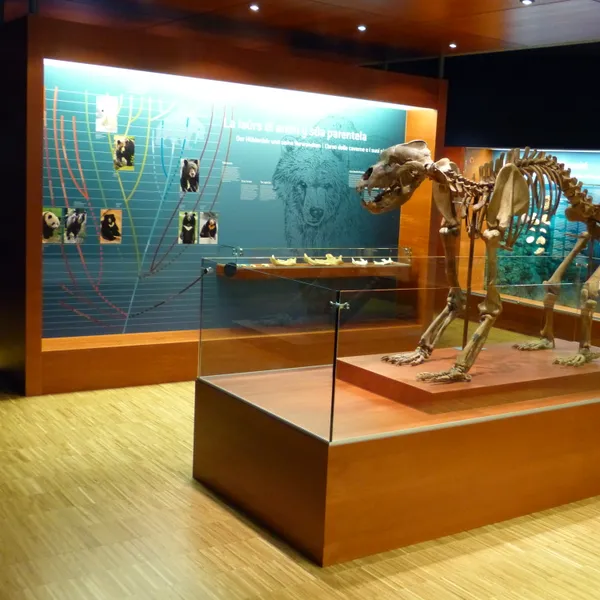
Two public institutes study and defend the language: the Istitut Ladin Micurá de Rü in San Martino in Badia, which keeps a specialist library, and the Istitut cultural ladin in Val di Fassa, a public body of the Province of Trento.
Our Dolomites trips
Rifugi booked, luggage transfers, support seven days a week.
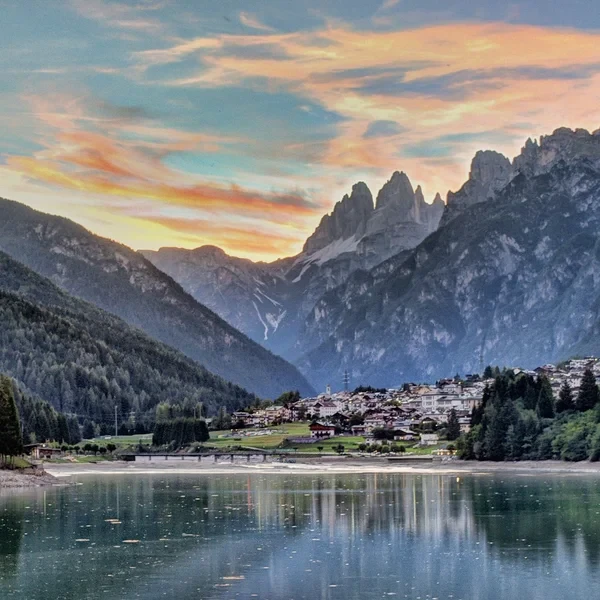
Dolomites Self-Guided Hiking around Cortina
A 7-day hotel-based hiking holiday around Cortina d'Ampezzo. Five day walks to Cinque Torri, the Tofane massif, Lake Sorapis and the iconic Tre Cime di Lavaredo circuit.
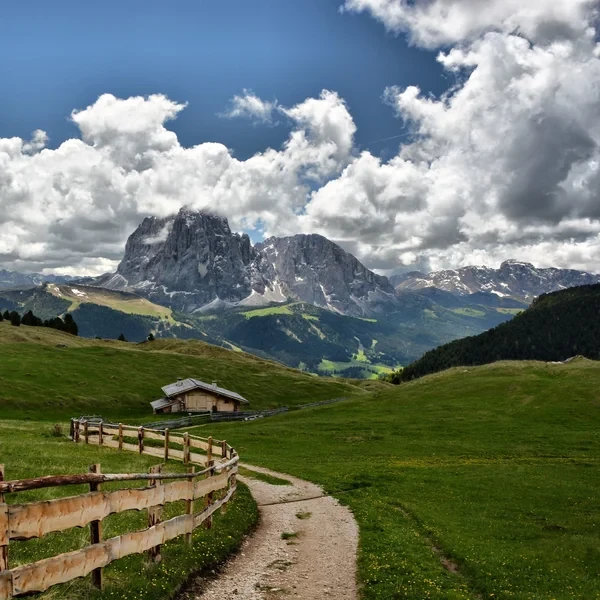
Grande Traverse of the Dolomites - Bolzano to Cortina
A 10-day self-guided traverse from Bolzano to Cortina crossing the Rosengarten, Alpe di Siusi, Puez-Odle plateau, Lagazuoi and the Tre Cime di Lavaredo - all with refuge half-board throughout.
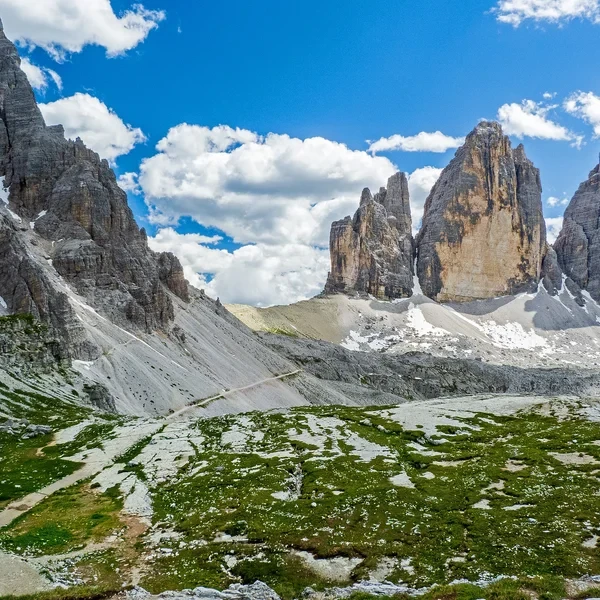
Guided Hiking in the Dolomites
Seven days of guided hiking around Cortina d'Ampezzo, visiting Cinque Torri, the Tofane massif, Tre Cime di Lavaredo, and Lake Sorapis. Hotel-based with half-board and all transfers included.

Grande Traverse: Verona to Venice
An 11-day guided traverse from Verona to Venice through the heart of the Dolomites. Rosengarten, Alpe di Siusi, Puez-Odle, Lagazuoi, and Tre Cime di Lavaredo - refuges throughout with cultural city bookends.